I know, you're probably tired of hearing about John Mitchell Kemble. But I had so much fun running across his various insults that I thought I would compile them for your (ok, my) amusement. He didn't pull any punches, as you'll see.
On 18th-century attempts to get rid of strong verbs:
These truly original and
groundforms of the language having been called irregular, a logical fallacy suggested to the purists that what was
irregular must be wrong…the wind blew and the cock crew no longer, -- they now blowed and crowed. In short,
these masters and doctors, though grammarians and lexicographers, knowed a thing or two less than they
ought.
[Footnote in unpublished review of Jakob Grimm's Deutsche Grammatik, p. 38]
On interpreting Old English based on Old Norse:
I beg once and for all to say that Norse forms have nothing whatever to do with Anglo-Saxon inscriptions. It was by trusting to Norse forms that Thorkelin misread every line and mistranslated nearly every word of Beowulf. It is by trusting to Norse forms that Dr. Repp has plunged himself into his ludicrous Christ-basin, and that Finn Magnusen has recorded his own rashness throughout 105 of the most adventurous pages I ever remember to have read.
[Anglo-Saxon Runes p. 56]
On other scholars' work on the Ruthwell Cross:
It is enough to say, that no such language ever existed as they find on this stone...[Magnusen invents] a new language, in which he says the inscription is written, and a people, by whom he says the language was spoken.
[Anglo-Saxon Runes p. 41, 47]
On a former student who published something from his collection without his permission:
I had the pleasure of
seeing my views travestied, my collections ill-used, and the whole subject on
which I have long been working most groundedly and seriously, taken out of my
hands, and miserably ill-treated in a flippant, superficial, wretched style, by
a man who has not a thought on the subject but what he has picked up from me…He is a literary pirate,
and as ignorant as he is impudent.
[Correspondence with Jakob Grimm, p. 112, 152]
On the Antiquarian Society's new committee:
Rather amusing that, is it not? A Saxon committee of which not one single member understands a word of Saxon.
[Correspondence with Jakob Grimm, p. 191]
On scholars clinging to old-fashioned and unnecessary Gothic typefaces:
It will be some time before the bibliomaniacal foppery of using these types ceases.
[Review of Analecta Anglo-Saxonica, p. 393]
On the most commonly-used Anglo-Saxon dictionary:
If ever a book was
calculated to do harm, to retard the progress of study, to perplex and fill
with trouble the mind of the learner, Lye’s Dictionary is assuredly that book.
[Review of Analecta Anglo-Saxonica p. 392]
On an anticipated new dictionary:
It will be a pitiful performance, for the man is as devoid of philology, as an ox of milk.
[Correspondence with Jakob Grimm, p. 57]
On the origin of Anglo-Saxon (aka Old English):
To suppose the Anglo-Saxon derived from a mixture of Old Saxon and Danish, is at once to stamp oneself ignorant both of Old Saxon, Old Norse, and Anglo-Saxon, and to declare one's incompetency to pass a judgment on the subject.
[Preface to Beowulf, p. xxii]
On the British Anglo-Saxonist establishment:
We could mention, were we so inclined, Doctors, yea, Professors of Anglo-Saxon, whose doings in the way of false concords, false etymology, and ignorance of declension, conjugation and syntax, would, if perpetrated by a boy in the second form of a public school, have richly merited and been duly repaid by a liberal application of ferula or direr birch.
[Review of Analecta Anglo-Saxonica]
The Oxford men have been railing at me, and at you too worse than the frogs at Latona: you will say as I do [Greek] which in plain English is, they may kiss mine A.
[Correspondence with Jakob Grimm, p. 90]
On the author of nasty letters to the editor about Kemble:
I know not whether he has filled, does fill, or means to fill the Saxon Chair in [Oxford]; but from the specimen of his ability which he has supplied in these letters, I can assure him that he is worthy to take his place in the long list of illustrious obscures who have already enjoyed that cheap dignity.
[Letter on Oxford Professors of Anglo-Saxon, p. 605]
Sunday, September 18, 2011

Wednesday, September 14, 2011
A weekend jaunt
After my last post, I met my friend Heather for lunch and hopped on a train to Exeter, about 2 1/2 hours from London, in the southwest of England. I had enough daylight left to wander around town and see the old city wall (you can see the bottom stones laid by Romans!) and the outside of the old Norman castle (William the Conqueror was here!). History nerdiness spiked, let me tell you. The next morning, I reported to my conference -- which turned out to be pretty small and mostly made up of grad students. The upside of this was that everyone got a chance to meet each other over the two days, and we all heard everyone's papers.
I gave my paper in the last session, so Heather was able to come and hear it. I'm delighted to say that I was very pleased with the paper I finally gave, though I'd been tinkering with it until the night before. By necessity, it didn't include everything I learned about Kemble over the summer, but I think I told a neat, clean story. And since, as I'd guessed, hardly anyone had even heard of him, I was safe as the Kemble expert of that particular conference.
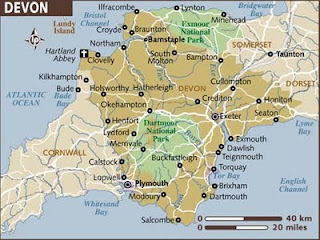 The next day, we set out on a weekend tour of southwestern England. First up was Dartmoor National Park; I wanted to go since it was so close to Exeter. Sadly, without a car and without bus services that only run on weekends, the best we could do was go to Okehampton (on the northwest border) and rent bicycles to go along the edge. Still, we took a little hike at one point just to see some wilder-looking countryside.
On Day 2 of our excursion, we headed east to Dorchester, the town on which Thomas Hardy based Casterbridge (see The Mayor of Casterbridge). This was because Heather is a Hardy fan and writing a chapter of her dissertation on his architecture. Therefore, we absolutely had to visit the house he designed and lived in. (Did you know he originally trained as an architect? I didn't.) We also stopped by the cottage where he was born and grew up.
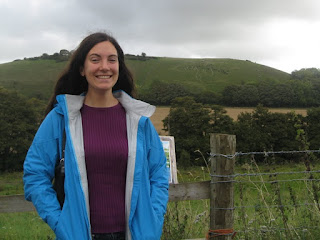
On our last day, we hit two ancient sites. First, and most giggle-inducing, was the Cerne Abbas Giant. (Pronounce that "Sern Abbas.") It's a figure drawn in a hillside just a bit north of Dorchester, just by scraping off the grass to reveal the chalk underneath -- and it's, well, anatomically correct. Read more about it here. We took a short hike up and around the field he's in, but (understandably) he's fenced off, so we couldn't get a good look at the drawing up close, just a sideways view of some squiggly lines.
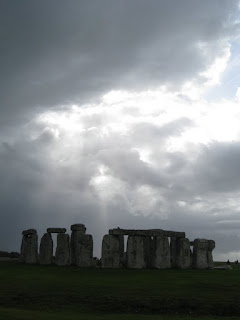
Last stop was Stonehenge. I had heard that it's fairly disappointing and all fenced off, but it's really not, at least if you've paid admission. In fact, the path gets quite close in certain spots. There was also a handy audio tour to explain the different sets of construction that happened over a few thousand years (what a timescale!). Of course, it was a bit hard to concentrate on some of it, because we got drenched in a little downpour. We were actually pretty lucky that we didn't get rained on until this point in the trip, and it was over pretty quickly. Plus, it gave us dramatic skies to make Stonehenge look even more mysterious.
We wrapped up by catching the tail end of evensong in Salisbury cathedral (love boys'/men's choirs!) and treating ourselves to a hearty and delicious meal at The Haunch of Venison, a restaurant that dates to at least 1320, when it was serving construction workers for the cathedral. That's crazy! All in all, a perfect weekend that went much, much more smoothly than our last outing.
I gave my paper in the last session, so Heather was able to come and hear it. I'm delighted to say that I was very pleased with the paper I finally gave, though I'd been tinkering with it until the night before. By necessity, it didn't include everything I learned about Kemble over the summer, but I think I told a neat, clean story. And since, as I'd guessed, hardly anyone had even heard of him, I was safe as the Kemble expert of that particular conference.
 The next day, we set out on a weekend tour of southwestern England. First up was Dartmoor National Park; I wanted to go since it was so close to Exeter. Sadly, without a car and without bus services that only run on weekends, the best we could do was go to Okehampton (on the northwest border) and rent bicycles to go along the edge. Still, we took a little hike at one point just to see some wilder-looking countryside.
On Day 2 of our excursion, we headed east to Dorchester, the town on which Thomas Hardy based Casterbridge (see The Mayor of Casterbridge). This was because Heather is a Hardy fan and writing a chapter of her dissertation on his architecture. Therefore, we absolutely had to visit the house he designed and lived in. (Did you know he originally trained as an architect? I didn't.) We also stopped by the cottage where he was born and grew up.

On our last day, we hit two ancient sites. First, and most giggle-inducing, was the Cerne Abbas Giant. (Pronounce that "Sern Abbas.") It's a figure drawn in a hillside just a bit north of Dorchester, just by scraping off the grass to reveal the chalk underneath -- and it's, well, anatomically correct. Read more about it here. We took a short hike up and around the field he's in, but (understandably) he's fenced off, so we couldn't get a good look at the drawing up close, just a sideways view of some squiggly lines.

Last stop was Stonehenge. I had heard that it's fairly disappointing and all fenced off, but it's really not, at least if you've paid admission. In fact, the path gets quite close in certain spots. There was also a handy audio tour to explain the different sets of construction that happened over a few thousand years (what a timescale!). Of course, it was a bit hard to concentrate on some of it, because we got drenched in a little downpour. We were actually pretty lucky that we didn't get rained on until this point in the trip, and it was over pretty quickly. Plus, it gave us dramatic skies to make Stonehenge look even more mysterious.
We wrapped up by catching the tail end of evensong in Salisbury cathedral (love boys'/men's choirs!) and treating ourselves to a hearty and delicious meal at The Haunch of Venison, a restaurant that dates to at least 1320, when it was serving construction workers for the cathedral. That's crazy! All in all, a perfect weekend that went much, much more smoothly than our last outing.
Tuesday, September 6, 2011
Back in the UK
Hello again everyone, this time from England.
Yes, those two weeks have elapsed, somehow. Hmm, how did I spend them? I picked up my new raincoat, which Marmot kindly replaced for me since my old one was losing its lining and therefore its waterproof nature. It's awesome that they provide that level of service, but I have to admit that part of me was sad to lose the jacket I wore nearly every day of my first year at Cambridge. I finished (or at least gave up on) my Kemble paper. I ate out at favorite restaurants and got in one day of quilting, which I haven't done in a year. And let's not forget watching Stanford's football team mop the floor with San Jose State, 57-3. That was a good last day in town.
On Sunday, I had a flawless travel day, which it's important to remember does happen sometimes. My flight from San Jose to Chicago was early leaving and had a tailwind, giving me plenty of time to mosey down to the next gate, and then we were nearly an hour early getting into London! Oh, and FYI: on Sunday of Labor Day weekend, a small airport like SJC has no one in it. There was literally no one behind me in the security line the entire time. When I arrived in London, I made my way to a hostel I like and met up with a couple friends for dinner. Then I managed to stay awake until a decent hour before crashing.
It's now morning, and I'm sitting in the hostel lounge looking out at the rain, wondering whether I should make an effort to go see/do something before taking a train to Exeter. I gotta say, the weather is not helping soften the blow of leaving home... Hopefully, a good week of conference and travel will cheer me up.
Tuesday, August 23, 2011
Many worlds
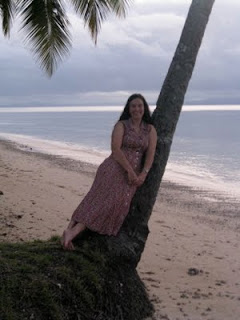
It may be a small world, but it never ceases to amaze me how many incredibly different and distinct worlds it contains. I just got back from nine days in Fiji, where the schedule most days looked like this:
 7:00am -- Wake up
8:00 -- Breakfast as a group
9:30 -- Children's/family snorkel trip
10:30 -- Adult snorkel trip (sometimes only one of these trips)
11:30 -- Shower off
noon -- Lunch as a group
afternoon -- Private group snorkel, scuba dive, or lounging by the pool
3:30 -- Tea time by the pool, check email on iPod
6:15 -- presentation by the marine biologist
7:00 -- Dinner as a group
9:00 -- Bedtime
Granted, this was at a resort and therefore isn't most people's normal life. However, there exists a place on this planet where people wake up every day under thatched roofs to tropical weather and could walk right out into an ocean filled with colorful fish. Meanwhile, in Palo Alto, people are looking out the office window at the leafy trees of suburbia and calculating the traffic on the roads, possibly looking up what classic movie is showing at the Stanford Theatre that night. At the same time, students in Cambridge might be fighting through the tourist crowds, zipping past 700-year-old buildings on their bikes. I'm not even mentioning the even more extreme versions of life that people experience in a given day -- my personal experience is enough to make me shake my head in wonder.
Now that I've returned to the U.S., I'm starting to write my conference paper on good old J.M. Kemble. I haven't read everything I intended to, but I already find that I'm going to have too much material for a 20-minute talk. I'll have to force myself to tell a focused story rather than try to spew all the juicy quotes I collected.
It's strange to think that in exactly two weeks I will be back in England... I find that when I'm in one place, I feel completely, naturally at home, and the other feels a bit like a dream. I'm also anticipating a blistering pace for the month of September. Once I finish this conference, I'll take another little weekend trip with my sister-in-law's sister (let's just say friend), then I'll have to read like crazy for another talk on the 24th, meanwhile expanding my Kemble report for an essay competition whose deadline is the 30th. These are all things I'm excited to do, I just wish I had double the time for each of them. Once we hit October, a new strangeness will occur: new incoming students to meet and make friends with. Some of my friends from last year will still be around, and some will not. The MCR seemed like a fairly cohesive group, so it's hard to picture the same thing happening again, but I'm sure it does every year. Meanwhile, back to the grindstone!
 7:00am -- Wake up
8:00 -- Breakfast as a group
9:30 -- Children's/family snorkel trip
10:30 -- Adult snorkel trip (sometimes only one of these trips)
11:30 -- Shower off
noon -- Lunch as a group
afternoon -- Private group snorkel, scuba dive, or lounging by the pool
3:30 -- Tea time by the pool, check email on iPod
6:15 -- presentation by the marine biologist
7:00 -- Dinner as a group
9:00 -- Bedtime
Granted, this was at a resort and therefore isn't most people's normal life. However, there exists a place on this planet where people wake up every day under thatched roofs to tropical weather and could walk right out into an ocean filled with colorful fish. Meanwhile, in Palo Alto, people are looking out the office window at the leafy trees of suburbia and calculating the traffic on the roads, possibly looking up what classic movie is showing at the Stanford Theatre that night. At the same time, students in Cambridge might be fighting through the tourist crowds, zipping past 700-year-old buildings on their bikes. I'm not even mentioning the even more extreme versions of life that people experience in a given day -- my personal experience is enough to make me shake my head in wonder.
Now that I've returned to the U.S., I'm starting to write my conference paper on good old J.M. Kemble. I haven't read everything I intended to, but I already find that I'm going to have too much material for a 20-minute talk. I'll have to force myself to tell a focused story rather than try to spew all the juicy quotes I collected.
It's strange to think that in exactly two weeks I will be back in England... I find that when I'm in one place, I feel completely, naturally at home, and the other feels a bit like a dream. I'm also anticipating a blistering pace for the month of September. Once I finish this conference, I'll take another little weekend trip with my sister-in-law's sister (let's just say friend), then I'll have to read like crazy for another talk on the 24th, meanwhile expanding my Kemble report for an essay competition whose deadline is the 30th. These are all things I'm excited to do, I just wish I had double the time for each of them. Once we hit October, a new strangeness will occur: new incoming students to meet and make friends with. Some of my friends from last year will still be around, and some will not. The MCR seemed like a fairly cohesive group, so it's hard to picture the same thing happening again, but I'm sure it does every year. Meanwhile, back to the grindstone!
Tuesday, August 2, 2011
Summer update
I started this blog primarily to give those who were curious a glimpse of my life abroad -- a response to the impossible, flustering question, "How's Cambridge?!" I also like that I'm writing down the medium-sized picture of what's going on every week or so, because while I keep a diary, it's mostly ramblings about how I'm feeling, not information that I'll want to remember later. In any case, though, I don't feel comfortable just leaving the blog alone while I'm at home, so here's a little update on how I passed July.
As you know, I've been reading up on my new buddy J.M. Kemble (see previous post). This involves cycling out to the Stanford library a few times a week and reading in the Lane Reading Room.
 It's funny, but when I walked in for the first time this summer, I was staggered -- almost offended -- by how much empty, open space there is between all the furniture in there. I hadn't thought about this before, but the Cambridge libraries pretty much all cram books and bookcases as tightly as possible into the space they have. Stanford's space felt like luxury indeed.
Dear, quick-tempered Kemble continues to amuse and enlighten. I get the sense that he would have been a fun guy to invite to dinner. No doubt I'm just indulging a fantasy, but it's fun to get to know someone from the past to whom few people really pay attention. I feel like we're buddies in a way that, I suspect, I will never feel about Tennyson. Maybe that's because T. could be grouchy and arrogant, but I think also because he's such common property that I can't get a sense of intimacy.
I've also started a bit of reading for a different presentation, which I learned recently I'll be giving at the end of September. This one is just an interdisciplinary colloquium within Cambridge, so I'm less nervous about it. The topic was so precisely on something I could talk about that I was pretty confident I'd get it, but it's always a great ego boost to get accepted. Plus, it gives me the chance to essentially do a book report on something I have to read for my dissertation anyway. I'll bore you with details another time.
The other big time sink has been learning to scuba dive. I'm taking a trip to Fiji in less than a week, and I was informed by good authorities that I simply could not go without scuba diving. So twice a week I've reported to the local dive shop, where paper tests and pool sessions prepared me for the ocean dives this last weekend. Said dives took place in Monterey Bay, in the cold, cold Pacific Ocean. I was fairly nervous, but my instructor was a real pro, and there were only three students, so everything was very calm and controlled. And having been to the Monterey Bay Aquarium many, many times, noodling around underwater was just like being inside the aquarium. What's scary about that?
So now I am a certified scuba diver -- hurray! I've been so distracted with that process and with reading that the trip itself has snuck up on me. Only a few more days before I leave, so it's time to start packing!
As you know, I've been reading up on my new buddy J.M. Kemble (see previous post). This involves cycling out to the Stanford library a few times a week and reading in the Lane Reading Room.
 It's funny, but when I walked in for the first time this summer, I was staggered -- almost offended -- by how much empty, open space there is between all the furniture in there. I hadn't thought about this before, but the Cambridge libraries pretty much all cram books and bookcases as tightly as possible into the space they have. Stanford's space felt like luxury indeed.
Dear, quick-tempered Kemble continues to amuse and enlighten. I get the sense that he would have been a fun guy to invite to dinner. No doubt I'm just indulging a fantasy, but it's fun to get to know someone from the past to whom few people really pay attention. I feel like we're buddies in a way that, I suspect, I will never feel about Tennyson. Maybe that's because T. could be grouchy and arrogant, but I think also because he's such common property that I can't get a sense of intimacy.
I've also started a bit of reading for a different presentation, which I learned recently I'll be giving at the end of September. This one is just an interdisciplinary colloquium within Cambridge, so I'm less nervous about it. The topic was so precisely on something I could talk about that I was pretty confident I'd get it, but it's always a great ego boost to get accepted. Plus, it gives me the chance to essentially do a book report on something I have to read for my dissertation anyway. I'll bore you with details another time.
The other big time sink has been learning to scuba dive. I'm taking a trip to Fiji in less than a week, and I was informed by good authorities that I simply could not go without scuba diving. So twice a week I've reported to the local dive shop, where paper tests and pool sessions prepared me for the ocean dives this last weekend. Said dives took place in Monterey Bay, in the cold, cold Pacific Ocean. I was fairly nervous, but my instructor was a real pro, and there were only three students, so everything was very calm and controlled. And having been to the Monterey Bay Aquarium many, many times, noodling around underwater was just like being inside the aquarium. What's scary about that?
So now I am a certified scuba diver -- hurray! I've been so distracted with that process and with reading that the trip itself has snuck up on me. Only a few more days before I leave, so it's time to start packing!
Thursday, July 14, 2011
Summer Research
Cambridge friends might be under the impression that I'm whiling away the lazy summer days in Californian sunshine, feasting on succulent strawberries as I lounge in the garden. Well, there is sunshine, but cold breezes have temporarily banished my shorts. And I am feasting on the finest berries that Whole Foods can provide (mostly blackberries) -- but my summer is hardly lazy.

This is because I (perhaps foolishly) submitted a proposal for a conference paper on a person I didn't know much about. It was accepted -- hurray! But now I have to learn all about this guy, mostly reading everything he ever wrote. I'm actually enjoying it a great deal, but time is of the essence in digesting a lot of material so that I can form some kind of argument or summary.

Meet John Mitchell Kemble.
He was part of the same secret society as Tennyson at Trinity College, Cambridge. He's considered the first modern scholar of Old English, and he did a lot to bring good practices to translation and interpretation. (First scholarly translation of Beowulf, and only the second one ever in England!) He also didn't mince words when he thought other scholars had blundered. This makes for some moments of pretty amusing reading. For example:
"I beg once and for all to say that Norse forms have nothing whatever to do with Anglo-Saxon inscriptions. It was by trusting to Norse forms that Thorkelin misread every line and mistranslated nearly every word of Beowulf. It is by trusting to Norse forms that Dr. Repp has plunged himself into his ludicrous Christ-basin, and that Finn Magnusen has recorded his own rashness throughout 105 of the most adventurous pages I ever remember to have read."
Other times, he's pretty dry. The other day I scrolled through a chapter that meticulously compared sources to figure out how big an Anglo-Saxon acre was compared to a modern one. Zzzzzz...
Anyway, I'm going to talk about him at a conference on how people have looked back at the Middle Ages for their own purposes. I expected Kemble to be much more nationalistic, but he's kind of all over the map. He wants to get his fellow Englishmen interested in their own national treasures and emulate the good parts of the past, but here's what he thinks of the Anglo-Saxons' sense of humor:
They were an extremely dull, calm, sober, common-sense people, and as for satire, God help them! they had not an atom.
So I continue reading, and eventually I'll put something together to talk about. It might just be a list of how he was a nexus of conflicting interpretations of medieval England. But I'll bet that very few in the audience will know as much as I do already about Kemble, so I'm not too nervous. But maybe that's just his arrogance rubbing off on me... :)
Tuesday, July 5, 2011
All good things must come to a (temporary) end
Well, I'm back home again after two last weeks of insanity and fun and sad goodbyes. Since I left you hanging with May Bumps, I'll finish that story. First, a picture of us with our first-day victory greenery:

The last two days of bumps, we had to row over twice a day, first to stay at the head of our division, then to try to claw our way into the next-higher division (unsuccessfully). It was exhausting and fairly frustrating to keep falling short, especially since we thought that if we had been fresh, we could have caught that upper division... In any case, the end result was a total of moving up four spaces (3 the first day, 1 the second) and never getting bumped by anyone else. This makes you eligible for "discretionary blades." But wait, what are blades, you ask?
Blades are the coveted award for bumps -- but they're often a matter of luck as well as skill, so they're hard to win. Physically, it means you get an oar painted with the names of the crew members, like this. To win them unequivocally, you have to have gone up at least four spots and have bumped at every opportunity (i.e., at least once a day). However, if you go up four and never get bumped, your boat club captain can choose to award you blades. And ours did! What a very Cantabrigian thing I will have on my wall forever and ever! :D Here's a celebratory picture with the flag, which represents winning blades.

After bumps, all the rowers celebrated with Boat Club Dinner, a convivial (read: drunken) event, as always. Then after a short night's sleep, I headed into my first Suicide Sunday. It's a day that consists of a series of garden parties -- men in blazers whose colors indicate the sports they play, women in summer dresses, everyone drinking bellinis and other cocktails. Why is it called "Suicide Sunday"? I've heard two theories: 1) It's so booze-soaked that you wreck yourself; 2) It's your last chance to kill yourself before exam results come out. Cheery, huh? In point of fact, it's fairly civilized: a chance to relax on the grass in the sun.
The week following was May Week, during which people attend various college balls. The only actual balls I attended were Queens' May Ball and Trinity Hall June Event (same idea but more casual and doesn't last all night). However, the week filled up with many other activities, as well. And then it was time for people to start dribbling away, some for good. It seemed like nearly every day there were sorrowful leave-takings. Eventually, I managed to scrape together some boxes in which to store my things and bid farewell (temporarily) to Cambridge myself. I'm so grateful for the amazing year I had, and I look forward to another great one. Meanwhile, time to do some research for my first "real" conference talk, first thing in September...

The last two days of bumps, we had to row over twice a day, first to stay at the head of our division, then to try to claw our way into the next-higher division (unsuccessfully). It was exhausting and fairly frustrating to keep falling short, especially since we thought that if we had been fresh, we could have caught that upper division... In any case, the end result was a total of moving up four spaces (3 the first day, 1 the second) and never getting bumped by anyone else. This makes you eligible for "discretionary blades." But wait, what are blades, you ask?
Blades are the coveted award for bumps -- but they're often a matter of luck as well as skill, so they're hard to win. Physically, it means you get an oar painted with the names of the crew members, like this. To win them unequivocally, you have to have gone up at least four spots and have bumped at every opportunity (i.e., at least once a day). However, if you go up four and never get bumped, your boat club captain can choose to award you blades. And ours did! What a very Cantabrigian thing I will have on my wall forever and ever! :D Here's a celebratory picture with the flag, which represents winning blades.

After bumps, all the rowers celebrated with Boat Club Dinner, a convivial (read: drunken) event, as always. Then after a short night's sleep, I headed into my first Suicide Sunday. It's a day that consists of a series of garden parties -- men in blazers whose colors indicate the sports they play, women in summer dresses, everyone drinking bellinis and other cocktails. Why is it called "Suicide Sunday"? I've heard two theories: 1) It's so booze-soaked that you wreck yourself; 2) It's your last chance to kill yourself before exam results come out. Cheery, huh? In point of fact, it's fairly civilized: a chance to relax on the grass in the sun.
The week following was May Week, during which people attend various college balls. The only actual balls I attended were Queens' May Ball and Trinity Hall June Event (same idea but more casual and doesn't last all night). However, the week filled up with many other activities, as well. And then it was time for people to start dribbling away, some for good. It seemed like nearly every day there were sorrowful leave-takings. Eventually, I managed to scrape together some boxes in which to store my things and bid farewell (temporarily) to Cambridge myself. I'm so grateful for the amazing year I had, and I look forward to another great one. Meanwhile, time to do some research for my first "real" conference talk, first thing in September...
Subscribe to:
Posts (Atom)