Wednesday, January 8, 2014

Happy New Year

You may recall from last year that I don't especially care for making New Year's resolutions.  I certainly didn't get my dissertation submitted in 2013, which was one of the few goals I set for that calendar year.  However, any chance to pause and reflect is a good thing in this frenzied world.  And I had a hell of a year to reflect on.

The first half of 2013 was crammed with crises, crying, and hard-won minor captaining victories.  But somewhere along the way I also discovered that I'd found a true friend in my buddy Martin, and having that kind of support on that side of the ocean has been an unexpected blessing.  Then there was a quiet summer, choir tour, a September of late nights in the library, a fall term of feeling that I was spinning my academic wheels, and finally the breakthrough of a good meeting with my supervisor.  I capped off 2013 the way I rang it in: dancing down Colorado Boulevard in the Rose Parade with the Stanford band, and cheering on the team at the subsequent game.  Sadly, this one reminded me far too much of the way the team used to play when I was an undergraduate.

I'm back in Cambridge now, after one of those long day-night-day travel slogs that make time seem a confused fantasy.  I'm told the UK has been experiencing massive storms while I was away, but tonight the air is calm and damp, the city quiet and expectant.  Here's to another new start.


Saturday, December 7, 2013

A perfect ending is still an ending


This is Phil.  Phil was one of the first friends I made in Trinity Hall, being a year ahead of me in the English PhD.  He had a rough time in the run-up to submitting, as you may recall.  However, he recovered his peace of mind in the following weeks, and yesterday he passed his viva (defense), as we all knew he would.  Celebrations were in order.

Over the course of the evening, many friends came and went, sharing their congratulations and joy over a pint or a whisky.  We made our way from the Castle down to the Maypole and finally made a quick stop at the ADC (theatre) bar, whence we departed in search of greasy food and at last collapsed into chairs in the MCR sometime between 3:00 and 4:00 in the morning.  When we realized we were all essentially falling asleep, we called it a night (or a morning?).  This morning, I helped Phil schlep his luggage to the taxi and sent him off with one last hug.

Since then I've just been poking around in a glorious, golden afternoon, waiting for Boat Club Dinner tonight and feeling a bit melancholy.  It's a funny feeling, that sedate little sadness, because it's not entirely sadness.  I'm so, so happy for my friend and proud of him both for writing a superb dissertation and for pulling through a difficult time.  I'm grateful that I was able to be there to support him when he needed his friends, and I'm touched by his earnest admonition that I call on him for the same kind of help if I ever need it, any time of day or night.  I had a wonderful time celebrating; it was the perfect end to his time at Cambridge.  But a perfect ending is still an ending.  As a fellow Tit Haller put it, "Phil is the MCR; I can't imagine it without him."  The beauty of the feeble amber light in the sky and the hush of college now that term is over just added to the perfection of a day that marked a chapter's closing.

Saturday, November 23, 2013

10,000 ways not to make a lightbulb

Supposedly, after trying hundreds upon hundreds of materials that might make a bright yet durable filament for incandescent lightbulbs, Thomas Edison said something to the effect that if he tried 10,000 things that didn't work, he had not failed, he had proved that those 10,000 didn't work.  The quotation has morphed with repeated telling to this pithy version: "I didn't fail, I found 10,000 ways not to make a lightbulb."

Recently, I was talking to a friend who is going to defend his dissertation soon (the same one who was so stressed before submitting -- see earlier post).  It struck me that there are many ways to write a PhD on any given topic, and part of why the process is so frustrating is that you are faced with 10,000 narrow, faded footpaths trailing off into the woods and you have to pick which dissertation you're going to write.  This involves venturing down a lot of dead ends and falling down the occasional rabbit hole before you settle on a solution.  It's a process of discovering and/or choosing all the ways not to write your dissertation.  Even then, you may be haunted by the ghosts of the 9,999 dissertations you didn't write.

I suppose a better analogy is Robert Frost's poem 'The Road Not Taken,' which is so often abused and oversimplified.  The point is that "both [roads] that morning equally lay / In leaves no step had trodden black"; one path isn't better than another, but no matter which one I choose, "I shall be telling this with a sigh, / Somewhere ages and ages hence."  In my friend's case, he wishes he had included more of certain primary and theoretical works on his topic.  Me, I wonder whether I did the right thing by slicing thinly (one-word examples) across a massive corpus of poetry.

Singing evensong in Queens' chapel
However, I'm feeling much more optimistic this weekend than I have since -- well, since the summer, really.  The summer months were consumed by two articles I was putting together, and ever since I've been slogging through the Slough of Doctoral Despond.  I could not figure out a way to bridge from lists of tiny examples to a narrative or argument -- and that's still a concern, one which looks to be resolved by means of an appendix.  But more importantly, in the process of trying, I produced a chapter-sized blob of text that my supervisor actually liked.  Gasp!  Say what?

I'm honestly still confused about what was different this time, especially given that much of the text was unrevised stuff he'd seen before.  Still, it's incredibly gratifying to hear him say that this now seems like a project that won't just "get through" but could be something really strong.  Huh?  And then there was one paragraph I had written about an idea that I liked but couldn't think of any way to expand; he thought this little thing was thoroughly original and should be an article in a major journal.  Come again?

My task now is to draw up a schema of everything that remains to be done.  *Deep breath*  What a difference this good feedback has made, though.  I celebrated that evening by making the most of a special joint evensong with Queens' College choir in their chapel, followed by formal (dinner) and drinks in the bar... and the Tit Hall MCR... and sleeping luxuriously late the next morning.  There may be 10,000 ways to write a dissertation, but it seems I'm finding mine.

Thursday, November 7, 2013

Look it up

As my brother will be happy to tell you, I spent much of my childhood sitting lengthwise on the loveseat, reading.  Consequently, my mom's household tasks were often punctuated by hollered conversations such as:

Sarah: What does 'bough' mean?
Mom: Spell it?
Sarah: B-O-U-G-H
Mom: A large tree branch.
Sarah: Ooooh, ok.  Thanks.

I could say so much about how great my parents were at encouraging reading, but that's a rhapsody for another time.  Today, I'm pondering one branch (bough?) of the phenomenon, the result of Mom starting to say, "Look it up."  You see, our household was among the last generation to have bought a full set of World Book Encyclopedias -- gilded paper edges and all -- and from a door-to-door salesman, no less, if memory serves!  This set included a two-volume dictionary, and as I got older I was increasingly referred to the bottom shelf of the bookcase to answer my own questions.

As a PhD student, I'm perpetually driven by the need to "look it up," but at the same time, that long-trusted process is supposed to be only the first step.  My supervisor is always pushing me to go beyond quoting other critics and disagree with them or at least assert something new.  This is what I struggle with just now.  I feel most confident in the "newness" of certain kinds of research, which in fact is just more looking it up.

For example, in one of his college-age notebooks, Tennyson made a little glossary of words from Old and Middle English.  I've transcribed it and am doing some detective work to create a list of his sources.  I'm then checking a concordance to see which little gems from his treasury he dropped into his poems.  Meanwhile, as I read through his Arthurian poems, the Idylls of the King, I collected samples of archaic words he used to give them a medieval flavor.  This is stuff I'm fairly confident has not been done.  But in the end, it's just information gathering.  What I then say about how that should influence our understanding of Tennyson's poetry is... shall we say... under development?  Or just underdeveloped.  Still, nothing solves blockage like a deadline, so I hope I will have something resembling a rough draft by the time I go home for Christmas.  Then commences ALL THE EDITING.

Thursday, September 19, 2013

Academic anxieties

This is what you get for taking
a cat nap near your friends.
Fear not, dear readers, I'm not in a panic about anything at the moment.  But I know some people who are.  Their PhDs are due imminently, and they don't feel ready.  One in particular has gone off the deep end, and it pains me to see it.  Actually, a more accurate metaphor would be that scene in "Robin Hood, Prince of Thieves" when Little John thinks he's drowning and Robin just says, "Put your feet down."  Turns out he's in about three feet of water.  Those who have rallied around my friend are trying to get him to put his feet down and discover the shallow depths of his problems, but in his mind-numbing dread, every molehill becomes Mount Everest.  Finding a moment when a critic he has roundly panned briefly agrees with his own conclusions does not, in fact, mean that his entire thesis will come unravelled.  I've read two of his chapters, and let me tell you: if I manage to tell a story with half as much clarity, precision, ingenuity, shrewdness, and beautiful turns of phrase as he has, I will count it a victory.  Unfortunately, by definition, you can't reason with irrationality.  All we can do is be firm and practical and give him hugs and tea.  By this time tomorrow, I hope all will be well -- assuming we've managed to wrench the thing from his trembling fingers.

Will I be this way when it comes time for me to submit?  All I can say is I hope not.  My closest academic friend/colleague here is a guy named Ian, who's at my college and doing a related topic.  I said to him the other day, "When it's our turn, we'll have to --"

"-- have a suicide pact?" he completed.  Uh, no.  I was going to say "keep each other sane", but you know, failing that...

So in the spirit of airing one's anxieties rather than letting them ferment and foment, I thought I'd lay out some of my concerns as I stare down the straightaway to "finishing" (i.e. giving up on) my dissertation.  Things that are particularly worrying given that it's my fourth year include (but are not limited to) the following:
The Anxieties

  • I still haven't read volume 3 of Tennyson's poems, and I definitely need to re-read vol. 2 in great detail.  As a result...
  • I still don't know which poems to talk about in detail.  I have amassed a large number of tiny examples sprinkled across many, many poems.  How do I avoid just listing them?
  • A lot of the most interesting stuff seems to happen in poems that he either didn't publish, fixed up before he did (thereby deleting the interesting things), or that generally weren't big hits.  Partly to counteract that, I've got a "greatest hits" chapter, meaning...
  • I'm going to have to talk about In Memoriam, about which there are a lot of books, some of which already have chapters about philology.
  • While the biographical and thematic connection of philology to Tennyson and poetry in general is pretty easy to prove, I'm struggling to say anything about his actual work that is different from what you'd say about any poet.  Poets like to play with language; that's why they're poets.  It catches your notice when, say, T. turns a noun into a verb, but when he writes of "the blackness round the tombing sod", is that because of the idea that nouns are the most solid part of speech?  And even if the answer is yes, you don't need to be an amateur philologist to think that.

I think that's all the big stuff.
What has struck me as I talk to people about their work is how we each have our own methods of producing the same basic thing.  Even though their approaches don't generally affect how I proceed, I always come away inspired to get back to work.  For example, a chat with Ian about the anxieties above sparked some ideas about how to acknowledge them in the introduction.  Here it is, a glimpse of what a very early proto-draft looks like for me.

With the years I've come to fear losing any flow of thought, given that they're so rare!  Consequently, I put in place-holders and highlight them in yellow so I can't possibly forget to fix them later.  Things I'm thinking of deleting I highlight in gray. I confess, it kind of amuses me to see what amounts to an academic MadLib; I wonder whether it would still work if, like when we were children, I filled in every blank with "toilet".  Something to keep in mind as a last resort when I'm in a panic at the last minute.

Saturday, September 14, 2013

Illusions

This is a topic that has been coming up a lot lately in everything from online videos to social research to opinion pieces, but to restate the case: social media create environments in which it's very easy to see the glossy surfaces of other people's (apparently) near-perfect lives.  As a net result, researchers tell us, things like facebook actually make us feel sadder, more alone, and less accomplished.  I'd like to point out that it's not entirely because people consciously construct a braggy version of their lives to show off.  In a very good online essay (see here), someone drew a Venn diagram* about facebook posts.  One circle was things that matter to the poster and one was things that benefit the reader (a funny link, etc.).  An ideal post covers both, whereas purely selfish posts -- either too positive or too negative -- are annoying.  Consequently, we try to strike a happy balance; something good happened, but be self-depricating about it; or you're having a rotten day, but express it in slightly cartoonish terms of dismay.

*Did you know Venn was a Cambridge alumnus and compiled a massive list of all known alumni from the beginning of the university to his own time?  He was at the college next door, Gonville and Caius.

Our folders are pretty on the front
and completely impractical to use
in performance.  I may donate money
someday just to get functional ones.
This self-evident truth -- that we're broadcasting curated, polished versions of our lives -- was brought home to me when I was catching up with hometown friends in August.  When I expressed some anxiety about being behind on certain landmarks of adulthood (they're mostly getting married and/or buying houses), they pointed out that based on my online presence, my life is the envy of everyone back home, friends who are perhaps working uninspiring jobs, who have precious few occasions to wear black tie, much less eat a formal dinner twice a week.  It came as rather a shock to them when I said that I'd been miserable most of last year.  Because I didn't post pictures of myself sobbing on my co-captain's shoulder (literally) or the nasty note someone wrote on my dinner program out of childish spite.  Why would I?  Let's just say that it was very therapeutic to delete hundreds of emails this summer and distance myself from the stressful year they represented.  No one who had a conversation with me during the last 12 months escaped hearing the truth of my situation, but those who only viewed from a distance had no clue.

In short, I hope that I haven't been too happy-slappy on this blog, but to the extent that I have given a false impression of my 'perfect and fabulous life', I apologize.  On the other hand, my mom reads these posts (hi, Mom!), so I can't say I'll be unleashing the full force of suckage when things are going badly.  But I'll try to be honest about the ups and downs.

One major up recently was the chapel choir's tour to Brittany in northwestern France during the last week of August.  One enterprising member of choir created a Twitter feed for the occasion; it's @TrinHallCC if you're into that kind of thing.  It will continue to be our feed as the year progresses, and even non-Twitter folks can follow it here: https://twitter.com/TrinHallCC/
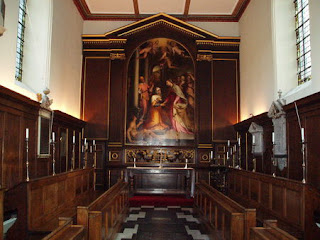
Trinity Hall chapel

The trip was great for group bonding, and I found it pretty exciting musically.  You see, we normally sing in the smallest chapel in Cambridge (or Oxford, for that matter).  It's a "dry" space, meaning basically no echo.  It's a bit like singing in a closet.  I actually love our chapel, but suddenly we were singing into big, stone churches where the sound lasted for many seconds after we stopped singing, and our voices blended into a whole new thing.  It's incredible what our director accomplishes with twenty-odd people, none of whom have perfect pitch!


I've put together a little video to go with a recording of one song from our first concert.  It's beautifully heartrending, yearning music.  Here are the words:

Thou knowest, Lord, the secrets of our hearts.
Shut not, shut not thy merciful ears unto our prayer,
But spare us, Lord.  Spare us, Lord most holy.
Oh God!  Oh God most mighty,
Oh holy and most merciful savior,
Thou most worthy judge eternal,
Suffer us not, suffer not at our last hour
For any pains of death, for any pains of death
To fall, to fall from thee.  Amen.


Thursday, September 12, 2013

The Ideal

I've read exactly two works by Plato.  One is Cratylus, which is a debate about whether words are arbitrary sounds that we all agree to assign to objects or whether they have some inherent correctness in naming the things they represent.  It has lots of yummy quotable bits about how language works, and it's great for my dissertation.  The other work, which honestly was a struggle back in college, was Phaedrus. In it, Plato spends lots of time explaining that every physical object in the real world is just a spin-off of an ultimate, pure form or idea that exists... somewhere (I never grasped where).

At the risk of being obnoxious, if the Platonic ideal of the academic life exists, I may be living it right now.  The tourists have mostly gone away from Cambridge, and I have the month of September mostly to myself, with literally nothing scheduled all day but to get on with work.  Much of the time I'm accompanied by my best buddy here, Martin.  Here's a picture from when we went hiking in his hometown in July.  There are a few fourth-year PhDs who are quietly panicking in the lead-up to submitting in a few weeks, but otherwise it's very peaceful.  Perhaps too peaceful -- I'm not getting much done, to be truthful.  But it's nice to be able to sit in the stillness for a bit longer.

In order to stave off panic, I've drawn out a calendar on a single sheet of paper that lays out everything between now and winter break.  It makes it seem possible that I'll get a full draft of this unwieldy thing by December.  I'd just feel better if I were making more hay while the sun shines.  That's a purely metaphorical sun, by the way, because about a week ago, someone upstairs flipped a switch and gave us mid-October after beautiful shorts weather.  Sigh.  Still, even rain on the river is pleasant in the private silence of having a floor of the library to myself.  Except that my tummy is squawking right now, so I think I'll join the MCR tea & cake gathering that's starting in a few minutes.

Stay tuned for my next installment, in which I make up for the 'image crafting' to which this blog contributes and give you a pretty piece of music.