Tuesday, October 9, 2012

Rowing and freshers

The new academic year is upon us.  I've been completely MIA to my family and non-Cambridge friends as I first spent a week rowing twice a day (see blistered hands, left and right) then a week welcoming all the new grads to Trinity Hall and trying to recruit freshers of every level to try rowing.  Practical results:

  • Drank a bit much on Saturday (MCR welcome drinks), Wednesday (boat club cocktails followed by MCR fun), Saturday (MCR cocktail night), and Sunday (first evensong of the year, yay choir friends!)
  • Didn't sleep nearly enough
  • Hundreds of emails sent and received
  • Did ZERO work
  • At least three fits of exhausted sobbing, mostly over organizing boat club stuff
  • Now have a sore throat

But the thing is, it's all completely worth it.  I admit, it's becoming more difficult to work up the enthusiasm for new people since they come and go so quickly, and I'm realizing that the ones worth knowing will continue to be around; a blitzkrieg of friend-making probably isn't necessary.  Nonetheless, a week of sociality is never a bad thing.  And the weather has been glorious for the most part.

Being women's captain has proved every bit as stressful as I'd feared, but I'm fortunate to be surrounded by people with better strategizing skills who loyally help me.  Adding to my discomfort (both emotional and physical), I have switched to rowing stroke side (blade on my right, not my left).  This feels odd, but it was necessary, and it's becoming more natural.  But the best thing about rowing lately is that we were honored by a visit from Tom James, who was an undergrad at Tit Hall not so long ago and just won his second gold medal in rowing.  See here: http://www.bbc.co.uk/sport/0/olympics/18911517 (he's sitting at the 3 seat with the cap and sunglasses).  He brought both medals and passed them around, and he hung out for the afternoon chatting with everyone.  AWESOME.  He also gave a little speech, and I was struck by the fact that when he rowed for Cambridge, he lost three out of four boat races against Oxford.  It just goes to show that a) results don't tell the whole story, and b) rowing is truly a team sport.  No individual can win a race for everyone else.

Thursday, September 20, 2012

Tables and graphs about words, oh my!

Good news first: I seem to have found much more evidence than I expected to show that Tennyson was influenced by Old English and old words.  My goal for the five weeks leading up to term was to write 10,000 words, and I'm 80% there with a week to go.  My slight concern is that my paper is filling up with tables, a graph, and calculations of percentages that I fear will bore my reader to tears.  But as requested (thanks, Adelaide!), here is a sampling.

Example #1
Let's show that Tennyson had an ear for the way Old English poetry sounded.  OE poetry had four stressed beats in a line.  The words that fell on these stresses alliterated (started with the same sound) in a certain pattern: the same sound in stress #1 or #2 (or both), plus stress #3.  And oh yeah, all vowels alliterate with each other.  Tennyson also liked four-stress lines, conveniently enough.  Here are some examples within the poem "Mariana" where he follows the old pattern:


Stressed syllable

1
2
3
4
Either at morn or eventide (16)
X

X

After the flitting of the bats (17)
X

X

She drew her casement-curtain by (19)

X
X

And glanced athwart the glooming flats (20)
X

X

The cock sung out an hour ere light (27)

X
X

The clustered marish-mosses crept (40)

X
X

All day within the dreamy house (61)
X

X

Which to the wooing wind aloof (75)

X
X


After that I talk about close-but-no-cigar lines that sound about the same to an amateur (i.e. Tennyson) but actually break the rules by including the fourth stress...

Example #2
It's a graph!  Heavens to Betsy.  "The Lotos-Eaters" is a fabulous poem that riffs on part of the Odyssey.  Go read it!  I'll wait. ...  I'm exploring the fact that a surprisingly high percentage of the poem's vocabulary is Germanic or Norse, not French/Latin.  In fact, it only averages 1-2 Romance words per line, with some sections having none at all.  How do I know this?  Because I counted.  I checked every word with the OED and made a pretty ugly graph.  In case it's not clear, the numbers on the y-axis are the lines of the poem.

As I was discussing this process with a friend, it became clear that someone with more linguistics and computer skills could probably make a project out of doing this kind of analysis on Tennyson's entire corpus (all 1,800 pages of it).  But it ain't gonna be me.

So there you have it, a humanities gal getting her hands dirty with organized information.  Really it's just a product of the fact that I find it much easier to grasp patterns when I see them visually displayed like this.  I read the rules for Old English alliteration many times, but as soon as I drew it out, it clicked.  Plus, I really didn't want to have pages and pages of text along the lines of, "And here's another example of where he does this."  I hope my supervisor finds it useful, too.

Meanwhile, I'm preparing to get rowing started again next week.  I got on an erg (rowing machine) last night for the first time in weeks, and it wasn't promising.  :P  I'm looking forward to getting on the water, but it looks like I will have to switch sides for now, and I know that will both feel weird and reduce my quality of rowing since I haven't done it much.  But to cheer myself up I watch this video of four of us at a regatta in August.  I'm sitting on the far right, nearest the cox.  We reconfigured the boat so that I could sit in that position and set the pace for everyone -- which made me nervous, but was kind of fun in the end.  Forgive the weird deformations as YouTube tries to eliminate camera movement...

Tuesday, September 11, 2012

Monastic life (mostly)

With the hustle and bustle of Olympics over -- at least the Olympics for which I had tickets -- I have no choice but to return to the library.  But don't feel too sorry for me.  At this point, even most of the grads and summer-research undergrads who were around for the summer have gone home, either because they finished their master's dissertations or just for a visit home.  This means I live a sort of monastic life of semi-solitude.  My day generally looks something like this:

9:30 -- Either just getting up or going sculling with a friend
11:30 -- Settle into my study nest in the Tit Hall library, write a little
1:00pm -- Lunch in the MCR or the lawn
2:00-5:00pm -- Write on my latest chapter until I reach 500 words
5:00 -- Coach people on rowing
6:30 -- Dinner in the MCR
7:00 -- Read

That looks very impressive and studious, but keep a couple things in mind: 1) I waste a lot of time doing other things (blargh, internet); 2) when term starts, I will have very little time for work thanks to being a rowing captain.  So I have to get stuff done now.

Pre-play entertainment at the Globe
But there have been some fun distractions.  One was a trip to the Globe Theatre in London -- you know, the one where Shakespeare worked.  Obviously it's a reconstruction, but I'm not complaining.  I was a "groundling," standing in front of the stage, under the open sky as it faded from blue to dusky purple.  The guy who played Henry V was fantastic, and they even managed to make the wooing scene believable, which I didn't think was possible.

Another diversion was a few days at a retreat/conference on "Life Beyond the PhD."  The English faculty had a bunch of money to send people and were practically flinging it at us, so I joined some thirteen compatriots and a load from other universities at the gorgeous Cumberland Lodge.  Honestly, I was most excited about spending a few days in a swanky country house, and it did not disappoint.  To the left is a picture of part of my room.  Best of all, the bathroom had an actual bath in it!  I used it every night.  :)
My room at Cumberland Lodge

On a walk in Windsor Great Park
Of course, there were also many opportunities to meet other PhD students from around the country, doing many different topics -- in fact, one whole day consisted of giving 10-minute presentations on our research.  It was a friendly crowd, and I even got to know some other Cantabrigians better when we took a long walk one afternoon.  The lodge is in the same park as Windsor Castle, so when the sun peeped out between gusts of chilly wind, it was a lovely place to stroll around.

Now that I'm back in the library, I'm pressing on through the molasses of taking my theories about philology's influence on Tennyson and showing them in his most famous poems.  At the moment, that means looking up every word of "The Lotos-Eaters" in the online Oxford English Dictionary to see what proportion of words he used were of Germanic vs. French/Latin origin.  I may even make a graph before I'm done -- how strange for an arts student!

Saturday, August 18, 2012

The Olympics!

I've been AWOL for a while now, my apologies.  Toward the end of my month at home, I got temp hired by the academic publisher I worked for briefly in 2008.  Wooo, much-needed money!!!  But it was earned by helping create a book index under extreme time pressure, so my last week was pretty much entirely spent in a cramped office entering code into LaTeX (pronounced lah-teck) and tracking down tiny differences that made five different entries for one thing.  Sort of interesting, but only because it was SHORT-TERM.

Once back in England, I was able to fulfill a dream I've had since 1992 and watch the Olympics live.  In 1992 the Olympics were in Barcelona, I was nine years old, and I fell in love with them.  Ever since, I've wanted to be there in person, and luckily for me, they came to within striking distance of a place I was actually living.  The online ticketing system was truly horrendous and made me despair of seeing much of anything: there was an initial lottery, then 6am releases of tickets during which the servers would crash, then miscellaneous releases as the weeks went past.  I got most of my tickets through this last method, though the website more often than not would show a session available, let you request them, then say there were no tickets.  Repeat ad frustratum.  In the end, here's what I saw, in order:

Road Cycling
This involved a very early morning to get from Cambridge to London, then across the city, then out on another train to Box Hill to line the road.  The course looped around the hill nine times, so we got to see changes in the groups.  The cyclists were really close to us bystanders, and you could feel the whoosh of wind off them.  Very exciting.  It was disappointing for GB fans that they didn't win anything -- especially since their team featured Bradley Wiggins, who had just become the first Brit to win the Tour de France.  Still, it was a festive atmosphere and a fun day out.


Here are Team GB leading the peloton, which is the main group that is behind the breakaway group that has sprinted ahead.  GB are in dark blue with white helmets.


Volleyball
Dominican Republic vs. Russia
USA vs. Brazil

This was dumb luck based on the bracket, but it was fantastic.  This pair of teams were in the gold medal match last year, so it was quality stuff.  Plus, there were two Stanford players on the court, one of whom (Logan Tom) made the winning spike.  Sweet!  Here she is serving.


Women's football (soccer)
Great Britain vs. Brazil
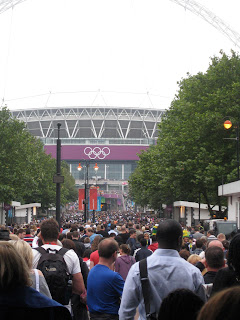
This may have been my favorite event, even though my understanding of soccer is limited to "They get the ball in the goal.  This doesn't happen very often."  Mainly, it was because the atmosphere in Wembley Stadium, which usually hosts professional teams, was absolutely electric; people were excited and cheering and doing the wave...  It's more than you get at most Stanford football games, that's for sure.  And GB scored the only goal of the match right in front of our seats, within the first two minutes!  Here's the view approaching the stadium and from my seat.


Canoe/kayak sprint
This was a bit of a dud, to be honest.  In addition to being somewhat boring to watch, the action was described by the two least informed commentators possible.  They clearly knew nothing at all about the sport, so the man basically said, "This is close!  Ohh!" over and over, without even informing us who had won, while the woman clearly had a fact sheet of which teams had won which recent competitions and just read them out.  Here's an actual exchange they had:

MAN: "That's a false start in lane 2.  What are the rules for a false start?"
WOMAN: [Looooong pause.]  "I don't actually know, to be honest.  I assume they'll restart."

Wow.

The most exciting thing about this event was that it was held at Eton Dorney, where all the amazing rowing had taken place earlier in the week -- GB kicking ass, including a Trinity Hall alumnus (Tom James) getting gold in the men's four.  Sitting right at 500m from the end, though, meant that a bunch of starts happened right in front of me.  Here's an example.


Women's wrestling
Medal matches for both weight classes
Yes, I wanted to see this since I wrestled in high school.  The matches went by really quickly, but it was again a loud, supportive atmosphere -- especially for the gold-medal winner, a Japanese woman who has won the gold now all three times that women's wrestling has been in the Olympics.  But I have to say, I was not impressed by the fact that tied periods are settled by picking a ball out of a bag, which gives one person a massive advantage such that she's almost guaranteed to win the period.  Sports should not depend on something so arbitrary.  Anyway, here's a shot of an American (in red) who eventually got bronze.

Sailing
So this one was quite far away.  So much so that by the time we got there, we caught the end of a semifinal, and then there was a delay because the wind died...And then they moved to a location farther away, which would have been fine except that they had no feed for the giant screen anymore because the BBC had packed up and left.  Boo.  But a gorgeous day at the seaside!

And so ended my firsthand experience of the Olympics.  London did a fantastic job of organizing travel such that everything went very smoothly.  I have yet to see the Olympic park, though, because none of my venues were inside it, and you had to have a ticket just to go in.  Oh well, it's not going anywhere, I guess.  I'm just so grateful to have gotten to see the things I did.

Saturday, July 14, 2012

Cleaning

There are any number of reflections, spiced with various levels of humor, on the amount of stuff in our lives.  (This assumes "we" are those lucky enough to afford possessions and have a dwelling in which to house them.)  Just look up a clip of George Carlin's stand-up bit about stuff for a good example.  I have no interest in covering that ground in detail yet again, but the fact is that I have been confronted by my stuff collection on a number of fronts recently, so it's on my mind.

Now, first, I'm not going to self-flaggelate much.  I don't think the amount of things I have makes me a bad person, especially since much of it was gifts or books bought for school or t-shirts that went along with activities I did.  I'm not drowning in my diamonds, in other words.  But I have become increasingly aware that I have stuff that fills a room in Cambridge, a closet and dresser at my parents' house (plus some storage rooms), and a room, kitchen, and store room at my apartment in Palo Alto.  Many of these items have made it through dozens of previous cleaning projects, but I'm pleased to report that eventually a time comes when I realize that I'm more sick of seeing a certain item than I feel sentimental about it.  When that happens, I can say, "Honestly, I'm never going to use this.  It can go away."  But there are challenges, of course.  My big stumbling blocks are:

  • Books.  Most are college books I've read and either want to display out of pride or think I might one day want to look something up in.  One shelf is yet-to-read.  One bookcase is childhood books that are sentimental and/or classics that it would be wrong to get rid of (all the Little House books, for example).
  • Magazines.  Why do I feel the need to read them cover to cover?  Because you learn unexpected and interesting things that way.  I'm just now eliminating a stack of magazines that dated as far back as 2008.  Three to go!
  • Clothes.  I'm not a stereotypical clotheshorse.  I don't yearn to go shopping, and I don't really like spending money on clothes, because it always seems like a lot for a single item.  However, I suffer from the "it's still good, it would be wasteful to throw it away" syndrome, combined with sentimentality when it comes to t-shirts.  While I think this is the ethical position to take, it also means you end up with, say, a number of oversized, faded (unflattering!) t-shirts from various Girl Scout events, or from national parks you visited with your family when you were about 12.
In short, it's always a matter of trying to assess how realistic it is that you might one day wish you still had that thing you got rid of.  I'm getting better at this, but one must persistently chip away.  With one week to go before I return to England, the pressure is on.

Wednesday, July 4, 2012

Living the good life

I can't believe I let a whole month go by, but it was a fantastic -- and fantastically tiring -- one.  I chose that word carefully, because the end of the year at Cambridge is more like a fantasy than reality.  To start things off, I had a positively glowing second-year review with my supervisor and another professor who also reviewed me last year.  We strategized about what I should do next and what I should expand, but they found my piece really interesting and somewhat novel.  Whee!  This is what helped assuage my guilt for not doing any work the following two weeks.  We won't dwell on the fact that my supervisor has said several times now (from the safety of now-I'm-on-track), "I was quite worried about you last year."  Yeesh!

Then there was the run-up to May Bumps.  I was in the second boat -- disappointing when I first found out, but it was a fun and talented group.  In fact, we came together such that, in pretty short order, we became the most balanced boat I think I've been in.  (Translation for non-rowers: we weren't tipping side to side all the time, which is both annoying and slows you down as your oars drag on the water.  Balance is hard to achieve, even with good rowers.)

We started off as the "sandwich boat" between divisions, just where my crew left it last year.  The first day we rowed over head of one division but didn't bump our way into the next one up.  The second day, we nearly managed to row over head again but got caught in the last stretch of the Reach (long straight part of the course).  So close, and yet so far.  The next two days, Cambridge's infamously gusty winds were our undoing, because while we were technically pretty rowers, we were also lightweights and were being chased by...substantial women.  But here we are, working hard:


You see me there sitting at seat 7, part of stroke pair.  This was a strange new experience for me; usually, because I'm so light and relatively unpowerful, I sit in at the bow end (front end, far right in this picture).  So I'm accustomed to seeing everyone in front of me and following along.  Sitting at 7 meant that people were following me, and I had to take it on faith that everyone else was back there behind me.  It was kind of flattering to be a semi-leader, though.  I'll need that next year, because I'll be the women's captain!!  I resisted running for weeks, because I was concerned about the time and stress it will involve, but eventually I realized (with much peer pressure...) that if I didn't do it, I would be sad for the lost opportunity.  So I will soon have embellishments for my new boat club blazer (see photo).  Fun fact: did you know that the word "blazer" was coined in Cambridge?

My black-tie partying actually started during Bumps (shhhh....), and it was an intense week-plus.  First there was the chapel choir's annual dinner, at which the tradition of "fining" ran wonderfully rampant.  Fining consists of mild-to-moderate embarrassment in the form of a central figure standing and announcing "I would like to fine the person who _____."  The person or people who fit the description then stand and take a sip of their drinks to acknowledge whatever trait or past behavior has just been named.  In a group that fundamentally likes and trusts each other, it's all fair in loving war to air the dirty laundry.

The following days included the MCR's farewell dinner, the termly Boat Club Dinner to celebrate the end of Bumps, Clare College May Ball, Trinity Hall June Event, and somehow throwing together the Gilbert & Sullivan Society's May Week show of "The Sorcerer," in which I had a small part.  After one of the worst springs on record, the weather was relatively good for Bumps and May Week, until the day of the show.  We stared down the prospect of performing in the rain in our garden theatre, until a miracle got us the ADC Theatre, one of the prime locations in Cambridge.  A good-sized audience turned up, and all came together for no good reason except perhaps good karma.

Then my body collapsed into a cold after 10 days of not enough sleep, I packed my room into storage, enjoyed the MCR garden party, and flew home.  Sunshine at last.

Thursday, May 24, 2012

Second-Year Springtime

Slogging through Tennyson can mean reading a lot of less-than-stimulating verse (in my humble opinion).  But then there are moments when you run across a gorgeous line or a sweet moment, and they make it worth while.  Bonus points for Cambridge references.  For example, here's a bit from a sonnet he wrote for a college friend who had died when they were both old men:

How oft we two have heard St Mary's chimes!     [The university church]
How oft the Cantab supper, host and guest,          [Cantab = Cambridge]
Would echo helpless laughter to your jest!
How oft with him we paced that walk of limes,    [path to the back entry of Trinity College]
Him, the lost light of those dawn-golden times,
Who loved you well!  Now both are gone to rest.
.................................................
                              dream of a shadow, go --
God bless you.  I shall join you in a day.

It's still not the most amazing stuff he ever wrote, but it's poignant.  I'm only halfway through his collected poems, but that hasn't stopped me from writing my second-year review piece.  It's nearly 20,000 words long, which is 1/3 of the minimum length for the complete dissertation.  It's a big stack of paper.  That big stack of paper is sitting at my left elbow as I write this, with notes from my supervisor sprinkled throughout it.  We had a good meeting last week, and basically she thinks it's an interesting subject and good material, but I need to make it clear what my claims are and why I'm using particular poems.

It's really exciting to hear confirmation that I'm on a path that will actually lead to a PhD.  I can see how much I still need to do -- discuss the work of other critics, for example -- but that's now in the context of filling out a shape I have in mind.

Meanwhile, spring/summer has suddenly blazed forth in Cambridge.  It's positively humid, and everyone has dug out their shorts and sandals from whatever cupboard they were buried in.  I have mounted to the top of the college library and have a gorgeous view of the sunset light on the spires of King's College chapel.  The sound of happy student chatter drifts up from Latham Lawn and through the windows that have been cranked open for the breeze.  It was only a few days ago that it was hard to believe we'd ever get clear sky and warmth again, and now winter seems aeons ago.  Here is a recording of the sounds from earlier this evening, the chapel bell at King's calling people to evensong: