Tuesday, June 14, 2011

A whimsical journey

[Useless rambling about the title.  Skip ahead for info about my weekend trip.]
In my graduating class, in the Stanford band, there was a guy named Tom Hennessey.  For years, he proposed a field show that would tell the story of the black plague from the point of view of the rat, ending with him arriving in England and having tea with the Queen.  This show never got voted in because, well, no one thought it was that funny.  What was funny was Tom's persistence in presenting this show, inevitably with the loud proclamation, "IT'S A WHIMSICAL JOURNEY!"  It seems appropriate for the random-ass trip I took with my sister-ish-in-law...

I won't bore you with the details of all the transportation connections we messed up, but we always got where we were going, even if it meant sampling the local cider in a pub while waiting for a taxi (how rough).  Here's the short version.

STOP #1: Tintern Abbey (just inside Wales)
William Wordsworth wrote a famous poem "written a few miles above Tintern Abbey" after a visit in 1789.  It's one of my favorites -- go Google it and read.  The actual Abbey is remarkably well preserved considering it was founded in the 12th century.  And for an extra bonus, they were having morris dancers perform that day -- as far as I could tell, this means hopping around with bells on your legs and waving handkerchiefs.  We had a lovely couple hours in the sun between rain showers.

STOP #2: Clevedon (Somerset)
This little coastal town used to be a modest Victorian resort.  There's a restored pier from that period, and we even saw a day-cruise ship dock as we ate dinner on a pub balcony:


It was a gorgeous evening, as you can see.  That night, and all the next day, it rained without ceasing.  Nonetheless, we walked down to a little church for the real reason we'd come: the grave of Arthur Hallam.  Hallam was Tennyson's bosom friend from the time they met at Cambridge and was engaged to Tennyson's sister.  He died very suddenly of a stroke at age 22, which devastated the poet.  During the ensuing years, Tennyson wrote a bunch of poems and pieced them together into his masterpiece, In Memoriam A.H.H.  The plaque to Hallam is inside the big window on the right of this picture.  His actual grave is somewhere nearby, possibly under the floor.

The Danube to the Severn gave
   The darken'd heart that beat no more;
   They laid him by the pleasant shore,
And in the hearing of the wave.

There twice a day the Severn fills;
   The salt sea-water passes by,
   And hushes half the babbling Wye,
And makes a silence in the hills.

The Wye is hush'd nor moved along,
   And hush'd my deepest grief of all,
   When fill'd with tears that cannot fall,
I brim with sorrow drowning song.

The tide flows down, the wave again
   Is vocal in its wooded walls;
   My deeper anguish also falls,
And I can speak a little then.


STOP #3: Chew Magna 
Never heard of Chew Magna?  You're not alone.  It's a one-horse town, but it holds something special for my sister-in-law's family, the Miners.  Their ancestor Thomas left Chew Magna in the 1600s to make his way to America.  When some Miners from America wanted to put up a plaque in the church in the 1970s, they discovered that the herald they'd been told they had by a shady genealogist in the 1700s was complete BS.  We wanted to see whether the plaque ever went up.  It did!  But without the heraldry.  I'll spare you that picture and leave you with me on the main street:
In short, it was a very quirky tour -- a whimsical journey, if you will.  It appeared that we were the only tourists in Clevedon and Chew Magna, and on one memorable occasion, we entered a pub and everyone turned and looked at us, perplexed.  That's how you know you've gotten off the beaten track!  But as long as there's cider in the pub, it's a good place to be.

Thursday, June 9, 2011

As Easter term rushes toward its end...

A few things to update you on as the term starts winding down.

First, I submitted all the paperwork for my first-year registration!  The big thing was a writing sample, which I felt was ultimately less complete than I would have liked.  Still, it showcases what I'd like to write about for the next couple years.  Here's the funny thing, though: after I had printed out everything, including statements of what I've been doing and attending all year, I signed the cover form and suddenly found myself stumped by the following: "The title of my proposed dissertation is ___________."  My topic has changed a fair amount from my admissions proposal, and I genuinely haven't thought about what to call it.  So 15 minutes before this thing was due, I sat in the library staring at this little bit of white space, trying to come up with something clever.   I didn't.  Placeholder it is: Tennyson and the New Philology.

Now I wait for the department to contact me about an in-person chat with two faculty members who are not my supervisor.  But do you think I'm relaxing?  Not a bit of it!  For one thing, I've been working on a proofreading project for quite some time now, sorely neglecting it the past couple weeks.  For the sake of professionalism, I really have to finish it up pronto -- hence my return to the library.

Meanwhile, rowing has ramped up in preparation for the May Bumps next week.  It took nearly all term to settle on a crew for W2 (women's second boat), so now we're trying to come together as a unit quickly.  To be honest, I've found it a frustrating term for rowing, because it feels like I'm getting worse rather than better.  I don't think that's actually true, but my half of the boat (and me particularly) are certainly getting a lot more commentary from the coach and the cox.  And the more they call out in piercing tones that convey annoyance that we're doing something wrong, just as I was focusing on fixing the last thing, the angrier I get.  It's not pretty inside my head at those times.  Then today, for extra fun, I had so much trouble breathing during a sprint that I was actually worried about my health, and so was the coach, based on my facial expressions.  I've never in my entire life had asthma, so this was both frightening and embarrassing.  Here's hoping it was a fluke panic attack or something.

Looking ahead: my friend/sister-in-law's sister and I are taking a weekend trip to some off-the-beaten-track villages on the border of Wales.  Bumps follows, after which will be the gloriously booze-soaked, sleep-deprived experience that is May Week in Cambridge.  So I should have lots to report in the coming weeks!

Sunday, June 5, 2011

What I've been doing

I always find it interesting when I sit down at a study desk to guess what the previous occupant is cramming for / researching, based on titles of the books stacked there.  As I put together my bibliography for the year's reading, it seems like a good way to show you what I've been doing all this time.  Keep in mind that many of these are articles or book chapters, not whole books, and a large chunk of them relate to a project I'm no longer doing.  Still, I'm pretty impressed with myself.


Anglo-Saxonism (aka what I'm not doing anymore)
‘J.M. Kemble and Sir Frederic Madden: “Conceit and Too Much Germanism”?’,

Old English Scholarship in England from 1566-1800

‘The Elstobs and the End of the Saxon Revival’

Anglo-Saxonism and the Construction of Social Identity

Anglo-Saxon Scholarship: The First Three Centuries

‘Received Wisdom: The Reception History of Alfred’s Preface to the Pastoral Care’

‘The Anglo-Saxon Grammars of George Hickes and Elizabeth Elstob’

‘Antiquary to Academic: The Progress of Anglo-Saxon Scholarship’

‘The Elstobs, Scholars of Old English and Anglican Apologists’

‘The Rediscovery of Old English Poetry in the English Literary Tradition’

‘Crushing the Convent and the Dread Bastille: The Anglo-Saxons, Revolution and Gender in Women’s Plays of the 1790s’

Literary Appropriations of the Anglo-Saxons from the Thirteenth to the Twentieth Century

‘Anglo-Saxon Attitudes?: Alfred the Great and the Romantic National Epic’

‘Historical Novels to Teach Anglo-Saxonism’

‘The Anglo-Saxons: Fact and Fiction’

Reversing the Conquest: History and Myth in Nineteenth-Century British Literature

Medievalism
Reinventing King Arthur: The Arthurian Legends in Victorian Culture

A Dream of Order; the Medieval Ideal in Nineteenth-Century English Literature

Romantic Medievalism: History and the Romantic Literary Ideal

Culture and language politics
Victorian Poets and the Politics of Culture: Discourse and Ideology

Philology
The Study of Language in England, 1780-1860

‘The Uses of Philology in Victorian England’

The Rise of English Studies; an Account of the Study of the English Language and Literature from Its Origins to the Making of the Oxford English School

The Tenth Muse: Victorian Philology and the Genesis of the Poetic Language of Gerard Manley Hopkins

Hardy’s Literary Language and Victorian Philology

‘Nationalism and the Reception of Jacob Grimm’s Deutsche Grammatik by English-Speaking Audiences’

Tennyson and His Circle
The Cambridge Apostles: The Early Years

The Cambridge Apostles: A History of Cambridge University’s Élite Intellectual Secret Society

Guessing at Truth: The Life of Julius Charles Hare (1795-1855)

John Mitchell Kemble and Jakob Grimm; a Correspondence 1832-1852

‘Middlemarch and Julius Charles Hare’

The Cambridge Apostles, 1820-1914: Liberalism, Imagination, and Friendship in British Intellectual and Professional Life

Tennyson: The Unquiet Heart

Theological Essays (by F.D. Maurice)

Notes on the Parables of Our Lord (by R.C. Trench)

Tennyson’s Poetry
‘Tennyson’s “The Princess”: A Definition of Love’

‘The Argument of “The Ancient Sage”: Tennyson and the Christian Intellectual Tradition’

Tennyson’s Language

‘Soul and Spirit in “In Memoriam”’

‘The Anti-Feminist Ideology of Tennyson’s “The Princess”’

The Spirit of God in the Old Testament.

Language and Structure in Tennyson’s Poetry

‘“Flowering in a Lonely Word”: Tennyson and the Victorian Study of Language’

Tennyson and the Reviewers; a Study of His Literary Reputation and of the Influence of the Critics Upon His Poetry, 1827-1851

The Language of Tennyson’s In Memoriam

‘“Knowledge of Their Own Supremacy”: “Œnone” and the Standardization of Tennyson’s Diction’

‘Tennyson and the Nineteenth-Century Language Debate’

‘Tennyson and Persian Poetry’

Friday, June 3, 2011

On the straightaway

Well, the race is nearly over, and the finish line lies straight before me.  I have three more days in which to polish up my end-of-year essay and write some blurbs about what I've done so far and what I'll do next.  Meanwhile, the weather is warm and sunny, and I gave a tour to a delightful family this afternoon, during which I got to deviate from the standard route and take them to lunch at Trinity Hall.  I'm delighted to report that they seemed convinced that it's the best college -- yay!  :D

And we're not entirely without fun, even in exam term.  A couple weeks ago, the MCR had its Annual Dinner, which was 1920s themed, so everyone looked fantastic.  Thanks to a helpful video from YouTube and a lot of bobby pins, I managed to transform my long hair into the appearance of a wavy period bob (see photo).  We also got to have pre-dinner champagne in the fellows' garden behind the master's lodge -- quite swanky.  Incidentally, I've now worn three of my four bridesmaid dresses in Cambridge, and I'm sure the last one will make an appearance before the year is out.  I think this speaks to a) brides I have known having fairly good taste, and b) Cambridge providing lots of black-tie events.

Wednesday, May 25, 2011

Are we there yet?

Preface:
There are so many people in Cambridge right now who have been studying like mad for weeks and who are staring down (or already suffered through) massive exams that determine an ungodly percentage of their degree results.  Compared to that, I'm having a walk in the park.  But still...

It's a bit of a stressful week.  The three big things I needed to write for this term were: a conference paper, an undergraduate lecture, and my first-year review piece.  Now, I actually had about the right number of words for all of these a week or so ago.  But somehow, the closer the conference got (it was a couple days ago), the more time I found myself spending on trying to get that paper in shape, neglecting the other two...This was capped by a last-minute paper exchange with a fellow student whose opinion I really respect, resulting in a flurry of editing before heading to London.

I'm happy to report that the conference was a fun though long day, showcasing people from incredibly different time periods and interests.  My talk was right at the end, but it seemed to go well.  Yay!  Now back in Cambridge, I have a few days to finish the other monster pieces.  [Quiz: who caught the reference to Sesame Street's "Monsterpiece Theater"?  If you don't know what I'm talking about, click here and watch the related videos.]

I've actually felt rather productive today -- but after most of a "productive" day, I've slogged through editing and adding to six pages.  Out of 20.  Oy vey.  Must must must make it all the way through the first-year thing today, then finish lecture tomorrow.  So it's the Mac and me and the Jerwood makes three tonight.  (Imagine that to swing music.)

Wednesday, May 18, 2011

Cricket explained for Americans

So in case you haven't been tracking my facebook status, I've actually gotten to play in a couple matches with the Cambridge University Women's Cricket Club.  This causes my friends to boast that "Sarah plays cricket for the university" -- which is not untrue, but somewhat deceptive in terms of how good it implies I am.  Still, for a cheap thrill, check out my player profile on the team webpage:
http://www.cucc.net/pages/Players-squad-Womens_Squad

Now, cricket has this terrible reputation for being impossible to understand.  Aaron Sorkin certainly seems to think so; there's a whole episode of Sports Night in which the cast and crew are trying to understand some incredible game so that they can talk about it on the show, and in an episode of The West Wing, President Bartlet quips, "Now, I am an educated man, Charlie, but when someone tries to explain cricket to me, all I want to do is hit him in the head with a teapot."

I'm here to insist that it's really, truly not that difficult to understand!  Especially if you already know the basics of baseball.  Part of the problem, I think, is the terminology -- so here it is, the basics of cricket explained using baseball terminology (forgive me, cricket fans).

Like baseball, you win by scoring more runs than the other team.  But instead of a diamond of four bases to run around, there are two bases that you run back and forth between, and the outfield is 360 degrees all around.

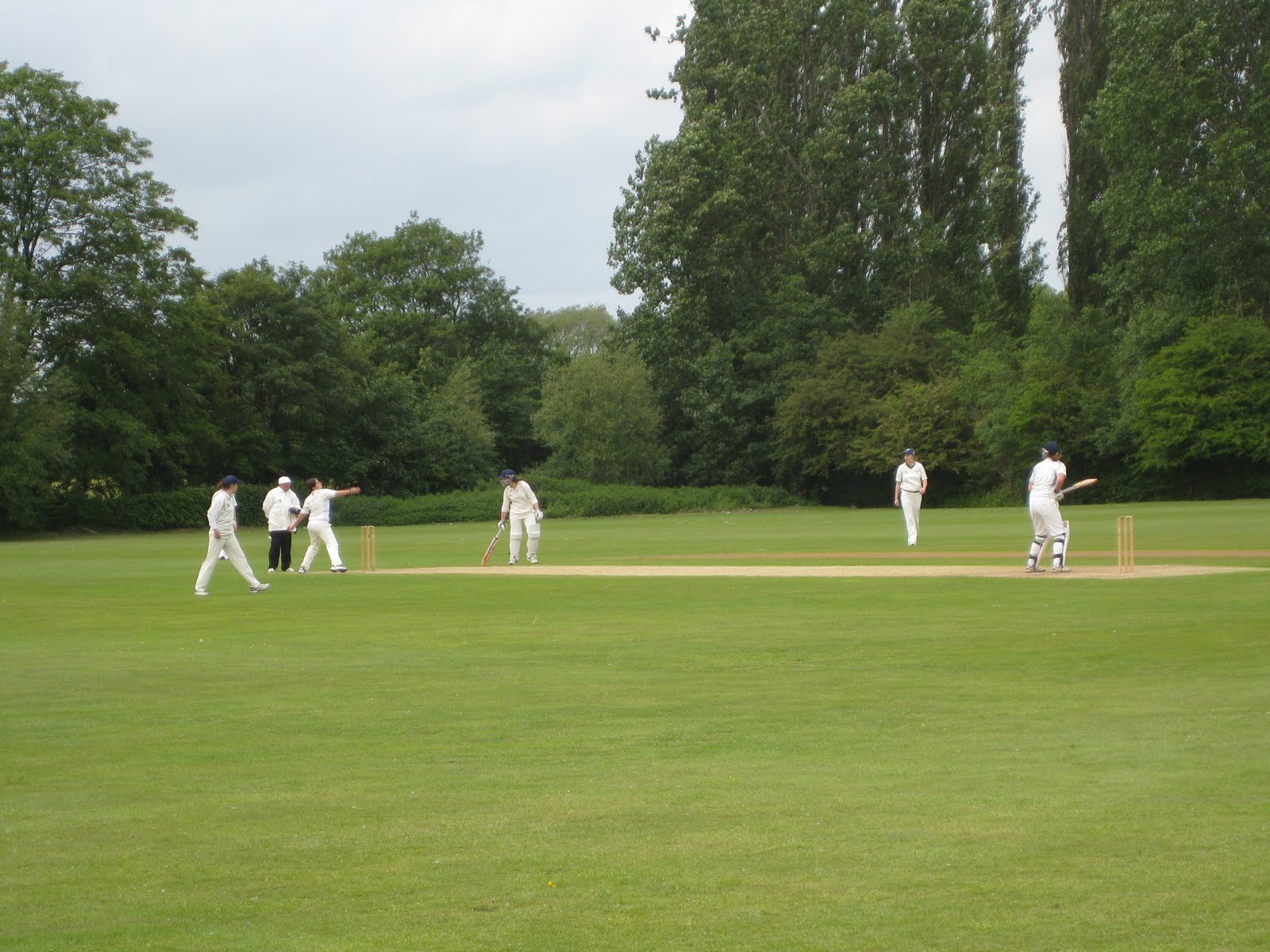
Like baseball, there's a batter who hits a ball in order to be able to run.  There's also an extra batter who runs back and forth.  They alternate who actually receives the pitch.  Here's a picture from our last match, which was against Oxford (click to enlarge).  On the left-hand side, next to the umpire in black trousers, you can see the pitcher ("bowler") about to throw the ball.  A bit to the right is the extra batter standing ready to run, and on the far right is the active batter with bat raised.


Like baseball, the batter is out if one of a few things happen:
  • the fielders catch a fly ball
  • the fielders get the ball back to one of the bases before the one of the batters gets there
  • the pitch gets past the batter and hits the wicket (3 sticks in the ground where a baseball catcher would be). [Note: there's no penalty for swinging and missing as long as the ball doesn't hit the wicket.]
  • the pitch hits the batter in the leg and that leg was directly in front of the wicket. (Without this rule, the batter could just stand completely in front of the wicket and make it impossible to get out that way.)
Like baseball, after a certain number of outs, the inning is over. In cricket, it's 10 outs. If 10 outs don't happen, the inning ends after a fixed number of pitches.
The big difference: instead of alternating batting and fielding throughout the game, one team does all their batting first, then you have a tea/lunch break, then the other team does all their batting. To be honest, I'm not a fan of this part, because it means that the team that bats first is playing in a vacuum and doesn't know how many runs they'll really need in order to win, whereas the second team simply has to get one more than their opponents.
So there you go! Not so bad, right? If you want to know more, Wikipedia's entry is pretty handy. It only remains to say that it's really fun to watch people's reactions to an American girl playing cricket. For one thing, it's not a super-common sport for women just yet, but more to the point Americans just don't know anything about it. Generally, people are surprised, amused, and impressed, in roughly that order.

Monday, May 16, 2011

Study nooks and rambling

As you saw in my last post, I have a few things that require me and my computer to be joined at the hip for the next couple weeks.  Over the course of the year, I've definitely found the spots where I work well, so allow me to take you on a tour.


Number one with a bullet is in the English faculty library.  The library has a number of large tables out in the open on the ground floor, but I feel on display there, and there's too much to look around at.  However, the "first" (American second) floor only partially covers the ground floor, and there's a little wall along the edge.  Along this wall and next to the bookcases are individual desks, and if I can snag one of these, I'm good to go.  They're bathed in natural light from the large windows, and you get a sense of people around you, but it also manages to feel fairly private.  Here's a view from about halfway down the line of desks:


What's that on my computer screen?  Glad you asked.  It's a section of my first-year review piece titled Richard Chenevix Trench and Popularizing Philology.  This Trench guy was a major influence in making the basics of language scholarship accessible and interesting for the general population.  There are about five books of his that I want to read over the summer.  He says great things like, "Language is fossil poetry...many a single word is itself a concentrated poem, having stores of poetical thought and imagery laid in it."  But moving on...


Happy place #2: Jerwood Library in Trinity Hall, mezzanine level, looking out at the lawn and King's College Chapel spires.


If this spot is occupied, I walk to the other side of the room and face across the public bridge (charmingly known as "orgasm bridge" because it's so steep that it's an effort to cycle up) and over the river to a little field.


In other news, by this time next week I'll have given my first-ever conference talk.  Check out the program (my session is at 3:00pm) by clicking here.